
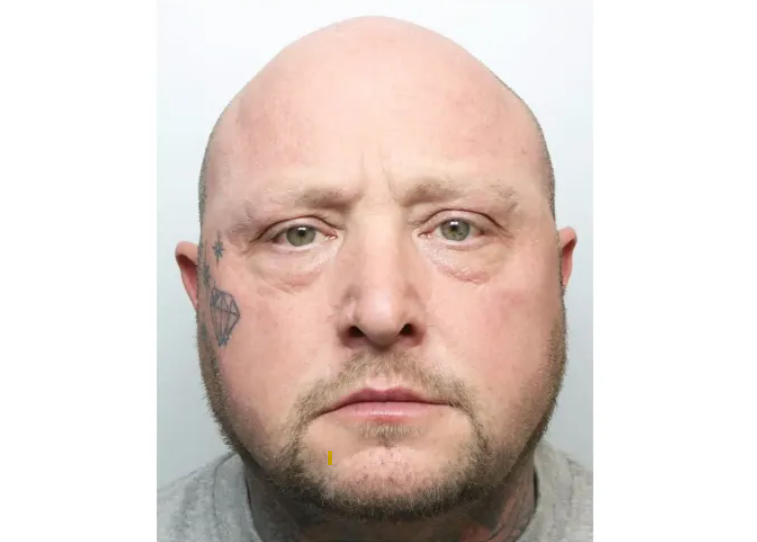
A British man who murdered his wife with a hammer and hid her body inside a freezer at their family home was already looking for romance just two days after killing her, prosecutors revealed.
David Barraclough, 46, was sentenced to life in prison on Friday, October 9, after admitting to the murder of his 37-year-old wife, Carolann Barraclough, a mother of three.
But it was his chilling behavior in the weeks following her death that left investigators particularly disturbed.
While Carolann’s body remained hidden inside a chest freezer, her husband was visiting local bars, withdrawing money from their joint bank account and downloading the dating app Tinder.
He was also sending text messages from his dead wife’s phone, pretending she was still alive.
According to Britain’s Crown Prosecution Service, Barraclough killed Carolann sometime between February 19 and February 21, 2026, at their home in Horbury, near Wakefield, England.
The court heard that he attacked her with a claw hammer while she was in bed. Her three children were inside the house at the time, although they did not witness the killing.
Afterward, Barraclough concealed her body inside a chest freezer in the utility room, where it remained for approximately two weeks.
Rather than immediately reporting her death, he began an elaborate deception to convince friends and relatives that Carolann was simply away receiving medical treatment.
He claimed she had become seriously ill and was recovering in a hospital, insisting that he was the only person permitted to visit her.
To make the story more convincing, Barraclough used Carolann’s cellphone to send messages to her loved ones, pretending to be his wife and reassuring them that she would soon return home.
He even sent messages to her children while their mother’s body remained concealed inside the family home.
Prosecutors said he deliberately prevented the children from entering the utility room where the freezer was located.
He later reset Carolann’s phone to its factory settings, an action investigators believe was intended to destroy evidence of his deception.
Meanwhile, his personal activities painted a very different picture from that of a grieving husband.
Financial investigators discovered he had withdrawn substantial amounts of money from the couple’s joint bank account.
Surveillance footage showed him regularly visiting local pubs, while phone records revealed he had downloaded Tinder just two days after killing his wife.
Additional evidence presented in court showed that Barraclough had contacted escorts and exchanged explicit messages with another woman.
The prosecution argued that his behavior demonstrated a calculated effort to continue enjoying his life while keeping his wife’s murder hidden.
The deception finally ended on March 5, when Barraclough walked into Normanton Police Station and made a startling confession.
“I’ve killed my wife,” he told a receptionist.
Officers went to the couple’s home, where they discovered Carolann’s body inside the freezer.
Despite confessing, Barraclough initially attempted to justify the killing by claiming he had been the victim of domestic abuse.
He alleged that Carolann had attacked him with a hammer and that he had acted in self-defense.
But investigators found evidence contradicting his account.
Prosecutors said surveillance footage from around the time of the murder showed no visible injuries to Barraclough’s face or body that would support his claim of having been attacked.
Investigators also examined his financial transactions, cellphone activity, surveillance recordings and witness statements to reconstruct what had happened.
Together, the evidence undermined his attempts to portray himself as a frightened husband who had acted out of desperation.
Barraclough eventually pleaded guilty to murder on October 6, the first day of his scheduled trial at Leeds Crown Court.
Three days later, Judge Andrew Stubbs KC sentenced him to life imprisonment with a minimum term of 22 years and one month before he can be considered for release.
In another troubling development, Barraclough refused to leave his prison cell to attend the sentencing hearing.
The judge proceeded in his absence, criticizing the violence of the killing and the way Barraclough had treated Carolann and her family afterward.
The court also heard evidence that Carolann had experienced years of abuse and violence at her husband’s hands, directly contradicting his claim that he was the victim in the relationship.
Senior Crown Prosecutor Jill May described Barraclough’s behavior after the murder as particularly revealing.
“David Barraclough tried to paint himself as a victim of domestic abuse who had no choice but to kill his wife and was heartbroken by what had happened. The evidence told a very different story,” May said.
She explained that his use of dating apps, withdrawals from the couple’s bank account and repeated lies to Carolann’s family were inconsistent with his claims of being devastated by her death.
West Yorkshire Police Detective Inspector Tom Hilyer also described Barraclough as manipulative and calculating, saying investigators had successfully dismantled his attempt to create a false defense.
For Carolann’s loved ones, however, the sentence cannot undo the devastation of losing a mother, sister and friend.
In an emotional statement read to the court, Carolann’s sister, Sarah Rowley, said the family had been shattered by her murder.
She described Carolann’s children as the center of her world and spoke of the enormous emptiness her death had left behind.
Prosecutors also praised Carolann’s eldest daughter for providing crucial evidence during the investigation, despite the extraordinary emotional burden of losing her mother.
Under British law, a life sentence does not automatically mean a prisoner will be released after serving the minimum term. Barraclough must serve at least the required period before becoming eligible for parole, and release is not guaranteed.
For Carolann’s three children, the case has left an especially painful legacy: their mother’s killer not only took her life but spent nearly two weeks convincing them she was still alive.
Authorities said they hope the conviction and life sentence provide at least some measure of justice for a family devastated by a betrayal that unfolded inside their own home.
