
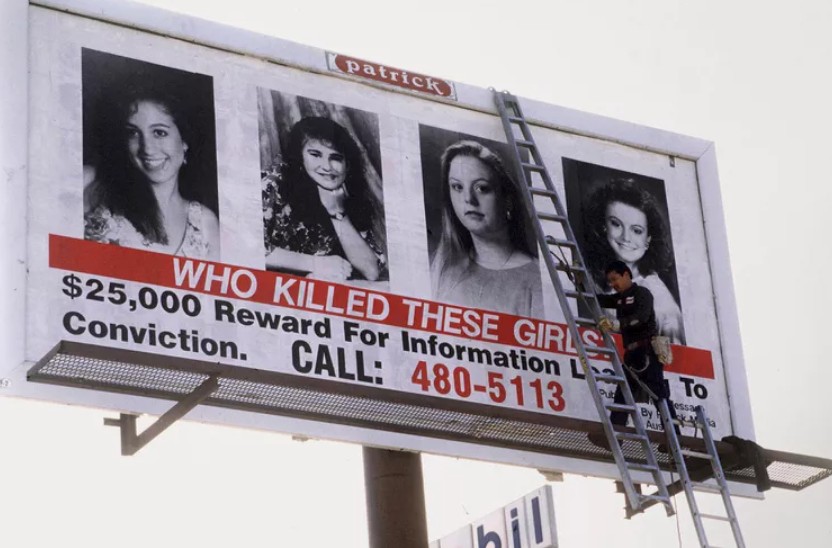
The night of Dec. 6, 1991, was supposed to end with a sleepover.
Instead, it became one of the most horrifying crimes in Texas history.
Four teenage girls were inside an I Can’t Believe It’s Yogurt shop in Austin that Friday night. Sarah Harbison, 15, and her friend Amy Ayers, 13, were waiting for Sarah’s older sister, Jennifer Harbison, 17, and their friend Eliza Thomas, also 17, to finish closing the store.
The girls were supposed to leave together for a fun night with friends.
They never made it.
As Jennifer and Eliza cleaned up the shop, putting away toppings, washing dishes and taking out trash, a man walked inside. What followed was a nightmare that devastated four families and haunted Austin for decades.
The attacker forced the girls to undress, sexually assaulted three of them, bound and gagged them, then shot each girl at close range. Afterward, he set the yogurt shop on fire, leaving their bodies badly burned and destroying much of the evidence.
For 34 years, the case remained one of the most infamous unsolved murders in America.
Then, on Sept. 29, 2025, authorities announced a stunning break.
Investigators said DNA had finally identified the killer as Robert Eugene Brashers, a known serial killer and rapist who was 33 at the time of the murders. Brashers is now dead, but police say the evidence finally answered the question that had tortured the victims’ families for more than three decades.
For Sonora Thomas, the younger sister of victim Eliza Thomas, the news was almost impossible to absorb.
Sonora was just 12 years old when her sister was killed. Now 47, she told PEOPLE she was “in shock” when she learned a serial killer had been linked to the murders.
“In some ways, there’s a strange relief, because the act was so evil,” she said. “This is an evil person who did this.”
The final chapter of the case is now being explored in the fifth episode of HBO’s docuseries The Yogurt Shop Murders. The episode, titled “The End of Wondering,” follows the long-awaited DNA breakthrough, the families’ reaction, and the damage done to the men who were once wrongly accused.
Director Margaret Brown said the pain of the case was nearly unbearable.
“It’s the worst thing that can happen to you,” Brown told PEOPLE. “For your daughter to be sexually assaulted and murdered, and then to not know who did it for 34 years.”
The case did not just destroy the lives of the victims’ families. It also shattered the lives of four young men who were publicly suspected for years.
Michael Scott, Robert Springsteen, Forrest Welborn and Maurice Pierce were all linked to the case during the original investigation. They were teenagers when police first questioned them in 1991.
Years later, in 1999, a police task force reopened the case. During long interrogations, Springsteen and Scott implicated each other and confessed. They later said the confessions were coerced.
All four men were arrested and charged with capital murder.
Springsteen was convicted in 2001 and sentenced to death. Scott was convicted in 2002 and sentenced to life in prison without parole. Welborn’s charges were dropped in 2000 after a grand jury declined to indict him. Pierce spent three years in jail before his charges were dismissed in 2003.
In February 2026, a district judge formally declared all four men innocent.
Still, the damage could not simply be erased.
“A lot of people think of me as a murderer,” Welborn says in the HBO episode. “It’s been really difficult.”
Maurice Pierce never lived to see his name cleared. He was killed in 2010 during a police confrontation. His daughter, Marisa Pierce, says in the documentary that the outcome still does not feel like true justice.
“I want to be respectful to everybody, but my dad will never come back,” she said. “It’s a little too late for him.”
The breakthrough came after Austin Detective Dan Jackson was asked to take a fresh look at the case in 2022.
Jackson reviewed the old evidence and began retesting items from the crime scene, using technology that did not exist when the girls were killed.
In June 2025, he sent a spent .380 shell casing found in a drain for retesting. On July 2, 2025, he learned the casing matched a bullet used in an unsolved 1998 murder in Lexington, Kentucky.
That clue led investigators to compare male DNA profiles from the yogurt shop case with other unsolved crimes across the country.
Then came the call that changed everything.
Officials in Greenville, South Carolina, said they had the same DNA profile in their database. It belonged to Robert Brashers.
Brashers had already been linked to the 1990 murder of Jenny Zitricki through genetic genealogy work by CeCe Moore in 2018.
Detective Jackson then worked to find out whether Brashers could have been in Texas at the time of the yogurt shop murders. The FBI provided a list of dates when Brashers had been stopped or arrested under his real name or aliases.
One detail stood out.
On Dec. 8, 1991, less than 48 hours after the girls were killed, Brashers was stopped while leaving Texas near Las Cruces, New Mexico, in a stolen truck.
That made investigators believe they were finally closing in on the man who had escaped justice for decades.
But Jackson still wanted stronger proof.
Because Amy Ayers had fought back during the attack, investigators tested DNA from under her fingernails. That evidence helped confirm Brashers as the killer.
“Amy’s final moments on this Earth were to solve this case for us,” Jackson said at the press conference. “It’s because of her fighting back.”
Brashers died by suicide in 1999 during a police standoff when authorities came to arrest him.
Even though the Yogurt Shop Murders are now considered solved, investigators believe Brashers may be connected to more crimes.
“I’m sure he’s good for more murders,” Jackson told PEOPLE.
Brown said she hopes the final episode of the HBO series will help people make connections that could lead to more answers in other cold cases.
In May, the city of Austin announced a $35 million settlement with the three surviving wrongly accused men and Pierce’s family. As part of the settlement, the city also agreed to ban unsupervised interrogations of underage suspects.
For Sonora Thomas, the answers came after a lifetime of grief.
She still thinks about her sister every day. She also thinks about her mother, Maria Thomas, who spent years tortured by not knowing who killed Eliza. Sonora said her mother died by suicide 10 years ago at age 60.
The randomness of the crime still haunts her.
“It’s painful to think how easily this could not have happened,” she said. “Our lives would’ve all been different.”
More than three decades later, the case that terrified Austin finally has a name attached to it.
But for the families who lost four girls, and for the innocent men whose lives were ruined along the way, the truth arrived far too late.
